
Best Dishwasher 2026: The Models That Balance Cleaning, Quiet and Price
When you buy through the Amazon links on this page, we may earn a commission at no extra cost to you. Learn more
Last updated October 31, 2026
The best dishwasher 2026 for most small kitchens is the Euhomy DW001-5 countertop dishwasher: it runs at 40 dB, washes a 30+ item load with dual spray arms, and gives you six programs in a footprint that sits on the counter instead of in a cabinet. If your kitchen has a narrow built-in opening, the balance shifts to a slim 18-inch machine with a stainless tub and heated dry.
Format decides most of the answer. A countertop unit trades load size for quiet and a low entry point, a slim built-in trades cabinet space for real drying and leak protection, and a standard 24-inch built-in takes a family's daily dishes.
The best dishwashers of 2026, ranked

Euhomy DW001-5 countertop dishwasher
See on Amazon
Hermitlux HDW5CW01 countertop dishwasher
See on Amazon
EdgeStar BIDW1802SS dishwasher
See on AmazonModel comparison
| Model | Price | Rating | Weight | Noise level | Voltage | Best for | |
|---|---|---|---|---|---|---|---|
| | Euhomy DW001-5 countertop dishwasher | $249.00 as of 10/31 See on Amazon | ★ 4.4 (1,000+ ratings) | 28.6 lb | 40 dB | 120 V | Renters and studio cooks wanting a short quick cycle and quiet run get a 29-minute wash and 40 dB operation. |
| | Hermitlux HDW5CW01 countertop dishwasher | $299.99 as of 10/31 See on Amazon | ★ 4.4 (4,600+ ratings) | 30.9 lb | 50 dB | 122 V | Apartment and RV dwellers wanting a lit view get an LED-lit black glass door and no-hookup tank. |
| | EdgeStar BIDW1802SS dishwasher | $539.00 as of 10/31 See on Amazon | ★ 4.2 (800+ ratings) | 62.8 lb | 52 dB | 120 V | Buyers fitting an 18-inch cabinet cavity who want leak protection get a sensor that shuts off water flow automatically. |
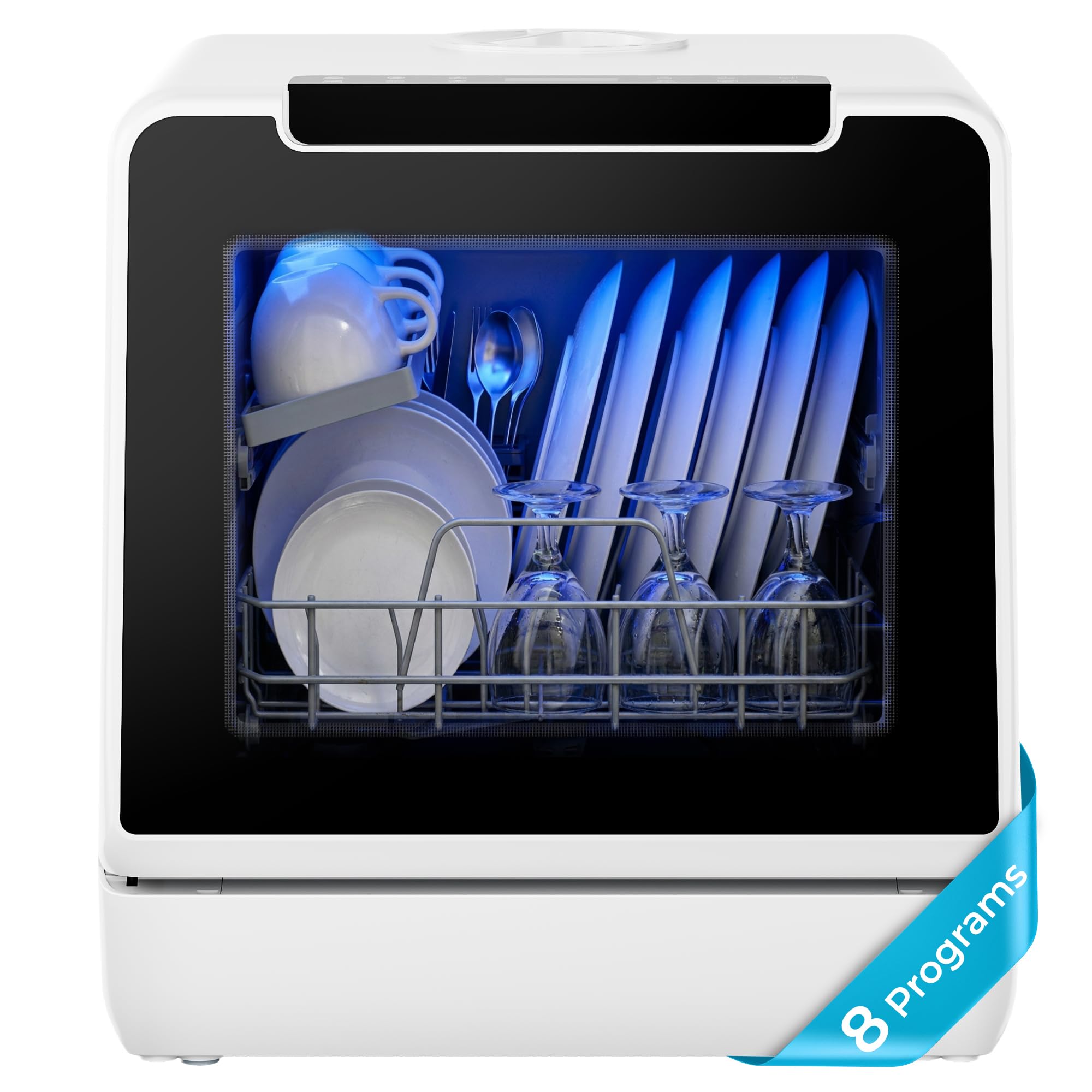 | Euhomy DW002-5A countertop dishwasher | $264.15 as of 10/31 See on Amazon | ★ 4.5 (300+ ratings) | 34.6 lb | 40 dB | not stated | Buyers wanting a self-clean cycle, delay start and child lock in one machine get all three on the touch panel. |
 | Comfee' CDF18A2BWW dishwasher | $398.99 as of 10/31 See on Amazon | ★ 4.3 (40+ ratings) | 54.7 lb | 52 dB | 120 V | Kitchens built around white appliances get a white finish plus a one-hour quick wash and cup shelves for tall glasses. |
What the format changes about cleaning, quiet and price
The three formats a US kitchen can take, countertop, slim 18-inch built-in and standard 24-inch built-in, do not compete on the same terms. Each one sets a ceiling on how clean, how quiet and how cheap a machine can be, and that ceiling is decided before you compare a single model.
Countertop units
A countertop machine sits on the counter, connects to the faucet through a supplied adapter and hoses, and washes a small load. Its footprint is counter space, not cabinet space, and its capacity is counted in items rather than full place settings. That is why a countertop unit can be very quiet and still cost little: it moves a small amount of water and has no cabinet to fit into.
Slim 18-inch built-ins
An 18-inch built-in slides into a narrow cabinet opening and is rated in place settings, typically 8 for this width. It brings what a countertop cannot: a stainless tub, heated drying, a leak sensor and a door that closes into the cabinetry. The price of that is installation and a cabinet cutout you have to measure.
Standard 24-inch built-ins
A standard built-in takes the full 24-inch opening and handles a family's daily dishes, sheet pans and large plates without a second run. It is also the format where quiet ratings and drying technology climb highest, and where the price climbs with them.
The practical rule: pick the format your kitchen allows first, then find the quietest, best-drying machine you can afford inside it. A quieter, better-cleaning model at a given price may simply not exist in the format you have room for.
Noise in decibels and what it means in an open kitchen
Dishwasher noise is rated in decibels, and the bands are easy to read once you know them. The low 40s is very quiet: you can hold a conversation next to it and watch TV in the same room. The low 50s is audible in the same room, but normal conversation continues without raising your voice.
The rating is a whole-cycle average, so a quiet number still means a machine running for an hour or more. Delay start matters as much as the dB figure: set it to run after bedtime and the difference between 40 and 52 dB shrinks to nothing in daily life. In an open-plan kitchen where you cook and eat while it runs, the low 40s is worth paying for.
Programs and controls you will actually use
Program counts run from 5 to 8, and the useful ones are a normal cycle, a quick wash, an eco cycle, a heavy or pots cycle and a rinse-only. A quick wash is the cycle that changes daily life: a 29-minute or 1-hour setting lets you run a small load before guests arrive. Specialty cycles such as baby care, fruit or glass are worth having only if they match what you wash.
Controls split between touch panels with LED displays on countertop units and push-button panels with LED on built-ins. The features that change daily use most are delay start and a child lock, both of which appear on several models here. A delay lets you run overnight on cheap power or after bedtime; a lock keeps small hands from starting a cycle.
Energy, water and the real cost of running it
Energy figures are stated per year or per cycle, and they are the honest way to compare running costs. An annual figure and a per-cycle figure are not on the same scale, so check which one a listing gives and convert both to a year of daily use before you judge.
An Energy Star rating means the machine meets the current federal efficiency thresholds for its size class, which is the simplest signal that it will cost less to run than a comparable model without it. Countertop units move a small volume of water, while built-ins draw more per load. The cheapest unit to buy is not always the cheapest to run, and the gap shows up over years, not weeks.
Warranty and service before you buy
Every model ranked here carries a 1-year warranty, and it is worth knowing before you compare anything else: a longer term is a bonus, not a given.
Check that a service option exists for the format and brand in your area before you buy. A built-in machine needs a technician who can pull it out and reconnect it; a countertop unit is easier to ship back. A local repair option matters more for a built-in than for a countertop machine, and it is a fact of buying rather than a comment on any brand's durability.
When to buy and the outgoing-model window
New dishwasher models arrive in fall, so outgoing models are discounted around then. Holiday sales, Presidents' Day, Memorial Day, Labor Day and Black Friday, are the reliable discount windows. For countertop and slim built-ins, stock and price move with these windows too, and the product cards show the current price.
If you are not in a hurry, buying in the weeks after a new line lands gets you last year's model at a lower price with the same cleaning and quiet figures. If your old machine has failed, the sale calendar matters less than getting a working dishwasher back in the kitchen.
What happens inside a dishwasher during a cycle
A dishwasher is not a sink full of hot water with a spinning arm. It is a timed sequence of fill, heat, spray, filter and drain steps, and each step explains something you will pay for when you compare models. Once you know the cycle, the spec sheet stops being a list of buzzwords and starts telling you where the money went.
The wash cycle, step by step
- Fill and heat. A water inlet valve opens and the tub takes in a few gallons, not a full tub. Most models then heat that water with an element or a flow-through heater to roughly 120 to 140 degrees Fahrenheit for the main wash. This is why a dishwasher needs a dedicated 120 volt circuit and a hot water supply line, and why a weak water heater makes any model look bad.
- Detergent release and prewash. The detergent door opens on a timer. Many cycles start with a short prewash that rinses loose food, drains, then refills for the main wash with fresh detergent. That two-stage start is a big part of why a dishwasher beats hand washing on water use.
- Spray arms and the pump. A circulation pump pushes water to two or three rotating spray arms, plus often a spray tower or dedicated bottle jets. Water pressure and arm coverage do the cleaning, not soaking. This is why loading matters: a bowl face down over a tine blocks the spray pattern behind it.
- Filtration. Water recirculates through a filter system. A fine mesh filter traps particles and needs periodic rinsing by hand. A hard food disposer grinds scraps and sends them down the drain, which means less manual cleaning but more noise and more parts. Know which one you are buying.
- Drain. A drain pump pushes the soiled water out through the drain hose, usually into the sink drain or a disposal connection, against gravity. A clogged air gap or a kinked hose is the most common reason a tub fills with standing water.
- Rinse and final rinse. Clean water rinses residue away. The final rinse is heated, and on high-temperature or sanitize cycles it holds a set temperature for a set time to meet sanitizing claims. The drying phase follows, and the drying section below covers each method.
What to check on the spec sheet
- Cycle length. Sensor or auto cycles now run from about one hour to three and a half hours or more, because they trade time for lower energy and water use. If you want fast, look for a stated quick cycle under 90 minutes and accept that it cleans less thoroughly.
- Sensor versus fixed cycles. A soil sensor adjusts water, heat and time to how dirty the load is. Fixed cycles run the same program every time. Sensor is the better default for daily use.
- Water and energy numbers. Energy Star standards for standard models cap annual use at 240 kWh and 3.2 gallons per cycle, based on 215 cycles a year. Compact models have lower caps. Compare the yellow label figures directly rather than trusting a marketing claim.
- Noise rating. The decibel figure is a whole-cycle average, so treat it as a rough guide. Under 45 dB is very quiet, 45 to 50 dB is quiet, and above 50 dB is noticeable in an open kitchen. A stainless steel tub usually runs quieter than a plastic one because it absorbs sound and holds heat.
- Filter type. Decide whether you want to rinse a fine filter every few weeks or own a grinder that handles scraps but adds noise and a wear part.
- Installation reality. Confirm you have a dedicated circuit, a hot water shutoff nearby, and a drain path.
None of this tells you which model to buy, and that is the point. Use the cycle to read a spec sheet: a short cycle time, a low decibel rating, a stainless tub and a drying method that suits your dishes are the features worth paying for. The rest is styling.
Types and form factors
Before you compare cleaning scores or decibel ratings, settle the format. The type of dishwasher you choose decides where it goes, how it installs, how much it holds and how much you can spend on the parts that actually clean. Each format suits a different kitchen, and each one has its own points to check.
Built-in (undercabinet) dishwashers
This is the standard format in US kitchens: a unit that slides under the counter, usually 24 inches wide and about 24 inches deep, plumbed into the cabinet run and wired to a dedicated circuit. An 18 inch slim version fits the same depth but trades capacity for width, which makes it the usual pick for small kitchens, apartments and accessory dwelling units.
- Who it suits: anyone with an existing cutout or a remodel in progress, and households that want the widest choice of racks, cycles, drying systems and noise levels.
- Check the hookups: a dedicated 120V grounded circuit, a water supply line and a drain connection. A straight swap costs far less in labor than a first-time install where lines have to be run.
- Check the capacity: a 24 inch model typically holds 12 to 16 place settings, an 18 inch model around 8. If you regularly run full loads for a family, the slim version will have you running it more often.
Portable dishwashers
A portable is a full-size or compact tub on casters with hoses that connect to your kitchen faucet. You wheel it to the sink, hook it up, run the cycle and roll it away. It needs no cabinet cutout and no permanent plumbing, which is why renters and people in older kitchens without a dishwasher opening gravitate to it.
- Who it suits: renters, small apartments and anyone who cannot or will not modify the kitchen. Many models have a finished top that works as extra counter space when the machine is parked.
- Check your faucet: the adapter needs a standard threaded aerator. Pull-down and hose-style faucets usually will not accept one, and that alone can rule the format out.
- Check your lease: some rental agreements restrict appliances that connect to the water supply, even temporarily.
- Check the footprint: you need floor space to store it and clear access to the sink during a cycle, plus somewhere to put the dishes while it runs.
Countertop dishwashers
These are compact units that sit on the counter beside the sink and connect to the faucet, holding a few place settings at most. They take counter space rather than cabinet space and wash a small load.
- Who it suits: one or two people in a very small space, or a secondary machine for a cabin or office kitchen.
- Check what fits: many models cannot take plates wider than about 10 inches, and tall glasses or stockpots are out. Measure your largest everyday items against the interior before you buy.
- Check the counter cost: the machine occupies a permanent block of counter space and needs to sit close enough to the faucet for the hose to reach.
- Weigh it honestly: for many households, hand-washing a small daily load is less hassle than owning one of these. It earns its place when you truly cannot plumb anything else.
Drawer dishwashers
Drawer models split the capacity into one or two independent pull-out drawers, each with its own controls. You can run a small load in one drawer while the other stays free, and a single drawer can be installed at a height that saves you from bending.
- Who it suits: households that run many small loads, people who want an accessible height, and kitchens where a standard door would conflict with a walkway or island seating.
- Check the plumbing and power: a double drawer needs supply, drain and power routed to the unit, and the cabinet design has to accommodate the drawer travel.
- Check the capacity math: each drawer holds less than a full-size tub, so two drawers are roughly comparable to one standard machine. Tall items may not fit in a single drawer.
- Check the price of flexibility: drawer formats sit at the top of the price range for the capacity they offer, so buy one for the layout or the loading style, not to save money.
How to decide
Work in this order. First, can you cut a cabinet opening and run plumbing? If yes, a built-in gives you the best cleaning, quietest operation and widest choice for the money. If no, decide whether you have floor space for a portable or only counter space for a compact unit. Choose a drawer model only when the split-load flexibility or the raised height solves a real problem in your kitchen. Once the format is settled, the rest of the comparison, noise, drying, racks and running costs, becomes much easier, and our dedicated guides for each format go deeper on the specifics.
How many place settings fit your household
Place settings are the industry's yardstick for capacity, and they are easy to misread. One place setting is a standard bundle of dishes for one person: a dinner plate, a salad or dessert plate, a bowl, a glass, a cup and saucer, and a fork, knife, spoon, and teaspoon. When a label says a model holds 12 place settings, it means the manufacturer fit 12 of those bundles into the racks under standard conditions. It does not mean 12 people's real dishes after dinner.
Why the label overstates real world capacity
The rated load is uniform and carefully arranged. Your load is not. Odd-shaped serving bowls, tall stockpots, stemware, and kids' cups eat space that the standard bundle never touches. In practice, most households fit closer to 70 to 85 percent of the rated count on a normal day, and less on holidays. Treat the label as a ceiling, not an average.
- Rack configuration matters more than the number. A model rated at 12 settings with fixed, tightly spaced tines can hold less than a model rated at 10 with adjustable tines and a flexible third rack.
- The third rack is bonus space, not counted space. It usually holds silverware, utensils, and small items, which frees the main racks for plates and bowls. That is a real gain even though it rarely changes the rated count.
- Tall tub designs buy vertical room. They let you stand dinner plates upright and fit taller items in the lower rack, which is where most real loads get cramped.
- Bowl tines and stemware clips change the math. Dedicated bowl rows and glass holders protect items but can reduce how many plates fit at once.
Match capacity to your household
Use the label as a starting point, then adjust for how you actually live. These are practical targets for a full day of dishes, assuming you run the machine once daily.
- One or two people: 8 to 10 rated settings is plenty, and an 18 inch model may be all you need. You will likely run it every other day.
- Three or four people: 12 to 14 rated settings is the comfortable range, especially if you cook at home and generate pots and pans.
- Five or more, or frequent entertaining: 14 or more rated settings, or a model with a genuinely useful third rack. Consider whether you would rather run two smaller loads than one crowded one.
- Heavy cooks: Add capacity headroom for sheet pans, mixing bowls, and large pots, which are the items that break a load.
What to check on capacity before you buy
- Measure your tallest and widest items. Check the lower rack height and the spacing between tines against your dinner plates, sheet pans, and stockpot.
- Look at the rack layout, not just the count. Adjustable upper racks, collapsible tines, and fold-down rows do more for real capacity than a bigger number on the spec sheet.
- Confirm the interior width and depth. Two models with the same exterior size can differ inside because of insulation and the wash system.
- Check the silverware setup. A basket takes lower rack space; a third rack or door-mounted slot frees it.
- Read owner comments about loading. Patterns in reviews about cramped bowls or awkward tines tell you more than the label.
Our take: pick the rack design you can load easily, then confirm the rated count clears your household by a setting or two. A slightly smaller machine that loads well beats a bigger one you fight every night.
How drying methods change your results and your energy bill
Drying is the part of a dishwasher cycle most shoppers ignore, and it is the part that decides whether you unload dry dishes or reach for a towel. Every model on the US market uses one of a few approaches, and each one trades off speed, plastic performance and electricity use differently. Here is what each method actually does and what to check before you buy.
Heated dry
A heating element at the bottom of the tub warms the air during the final phase, and some models add a small fan to push that warm air around. It is the most forgiving method for mixed loads.
- Results: The most reliable drying for plastic, which does not hold heat the way ceramic and glass do. Expect few water beads on lids and containers.
- Energy: The highest draw of any method because the element runs for a meaningful stretch at the end of the cycle. Many models let you switch it off, which saves energy but leaves plastic wet.
- Check: Whether heated dry is optional and whether there is a separate fan-only or air-dry setting. A model that forces heated dry on every cycle costs you money you cannot avoid.
Condensation dry
No element runs at the end. The final rinse water is hot, the stainless tub holds that heat, and moisture condenses on the cooler walls and drains away. This is the baseline method on most midrange and premium machines.
- Results: Excellent on glass, ceramic and stainless. Weak on plastic, which stays cool and collects droplets. If your load is heavy on plastic, expect to hand-dry or crack the door.
- Energy: The lowest of the three because the drying phase draws almost nothing beyond the hot rinse. This is the method most Energy Star listings rely on.
- Check: Tub material. A stainless steel tub is what makes condensation drying work, so a plastic tub paired with this method will underperform. Also look for a rinse aid dispenser, since rinse aid is what sheets the water off and makes this method viable.
Zeolite and fan-assisted drying
These are enhancements layered on top of condensation drying rather than separate categories. A zeolite system uses a mineral that releases stored heat into the tub to dry the load, and fan-assisted systems (sometimes paired with an automatic door opening at the end of the cycle) move moist air out or circulate warm air through the tub.
- Results: The strongest drying you can get, including on plastic. Auto-open door systems vent steam and let ambient air finish the job, which works well but means the door sits ajar for a while after the cycle.
- Energy: Lower than heated dry in most cases because the heat comes from the wash water and the mineral rather than a live element. Fan-assisted systems use a small amount of electricity to run the fan.
- Check: Whether the door-open feature can be disabled, since an open door is a safety concern in a kitchen with small children or pets. Also confirm the fan or mineral system is covered by the warranty, because these are the parts most likely to need service.
What to check on the spec sheet and in the store
- Match the method to your load. If most of what you wash is plastic, prioritize zeolite, fan-assisted or heated dry. If your load is mostly glass and dishes, condensation dry is efficient and effective.
- Look for a disable switch. The best setup lets you turn heated dry off for everyday loads and on when you need it.
- Confirm rinse aid is in the loop. Every drying method except heated dry depends on rinse aid to work as advertised. Budget for it as a running cost.
- Read the energy label against the method. A low annual energy figure paired with heated dry usually means the rated cycle skipped it. Ask which cycle the rating reflects.
- Check the door-open clearance. If the model vents by opening the door, you need clear space in front and no cabinet or drawer that blocks the swing.
Drying is the one spec that changes what you do after the cycle ends, so weigh it against how much plastic goes in your racks before you decide.
What the controls add to a best dishwasher
Controls and connectivity are where dishwashers have changed the most in recent years, and also where it is easiest to pay for things you will never use. Panel location, display readability and offline operation are the points that decide whether the extras earn their place.
Front controls versus top controls
Front controls sit on the face of the door, so you can see and reach them at any time. Top controls sit on the upper edge of the door and are only visible when the door is open or the unit is pulled out slightly. Top controls give you a cleaner front panel and put the buttons out of reach of small children, but you have to open the door to check remaining time or change a setting. If you start cycles often and like to glance at the countdown, front controls are more convenient. If you have young kids or want an unbroken panel look, top controls are the better fit.
Display readability
Look at the display in person if you can. Check these points:
- Contrast and brightness. A dim LCD or a faint LED is hard to read in a bright kitchen. Some displays wash out under direct sunlight.
- Countdown timer. A remaining-time readout is far more useful than a simple set of indicator lights. Confirm it counts down rather than just showing the selected cycle.
- Floor projection. Some models project the remaining time or a status light onto the floor. This is genuinely handy on a quiet model, since you can see the status without opening the door or listening for water.
- Button type. Membrane buttons are sealed and easy to wipe. Physical buttons give clearer feedback. Touch panels look sleek but can be fussy with wet or floury fingers.
- Child lock. Worth having if anyone small can reach the panel.
Delay start and other timing controls
Delay start lets you run the cycle later, which matters if you are on time-of-use electricity rates or want the noise to happen while you are out. Check how far the delay reaches (a few hours versus up to 24) and whether it is easy to set and cancel. Also look for a half-load or upper-rack-only cycle if you often run partial loads, and a quick or express cycle if you need dishes back fast. These timing options affect daily use more than most connected features do.
Which connected features are actually useful
Wi-Fi and app control are common now, but the value varies a lot. These are the ones we think earn their place:
- Cycle notifications. A phone alert when the load finishes is the single most useful connected feature, especially on a very quiet model you cannot hear from another room.
- Remote start. Useful if you want to trigger a delayed or off-peak cycle from elsewhere. Check that it works reliably and that the app is not required for basic operation.
- Diagnostics and alerts. Error codes and maintenance reminders sent to your phone can save a service call.
- Downloadable or extra cycles. Occasionally useful, but treat these as a bonus, not a reason to buy.
Be skeptical of features that only duplicate the panel, require an account you do not want, or depend on a cloud service that could be discontinued. A dishwasher should work fully from its own controls if the app or your network is down. Confirm that before you buy, and check whether the manufacturer has a track record of keeping its app supported.
Controls to check before you buy
- Panel location and reach. Make sure the controls are comfortable to use at your counter height, especially with top controls.
- Display in your lighting. View it in a store under bright light if possible.
- Delay range and cancel. Confirm the delay window and that you can cancel a running or delayed cycle easily.
- Offline operation. Verify the unit runs all core cycles without Wi-Fi or an app.
- App support and privacy. Read what data the app collects and whether updates are promised.
- Child lock and floor light. Decide whether these matter for your household.
Spend your budget on cleaning, quiet operation and a stainless tub first. Then use controls and connectivity to break ties between models that already perform well.
Racks, baskets and loading
The rack system decides what actually fits and how clean it gets, and it is the part of a dishwasher you touch every single day. A machine with strong wash performance and a poorly designed interior will still frustrate you. Before you buy, look past the place setting count and study the layout.
Third racks are useful, but not all equal
A third rack is a shallow tray or set of tines at the very top of the tub. It adds usable space for spatulas, ladles, long knives, lids and small bowls that would otherwise rattle around the main baskets. The catch is headroom: a third rack steals height from the middle rack, which can matter if you load tall glasses or stockpots there.
- Full-depth trays hold the most and often include a dedicated spot for silverware, freeing the lower basket.
- Half-depth or shallow racks take less room from below but hold less themselves.
- Check adjustability. Some third racks can be removed or lowered so you can reclaim height when you need it.
- Watch the spray arm. A third rack should not block the upper spray arm from reaching the middle rack.
Adjustable tines and folding sections
Fixed tines force every load into the same grid. Adjustable or folding tines let you collapse a row to lay down a casserole dish, a cutting board or a large platter flat. Look for tines that fold in groups rather than one at a time, and check that the folded position locks so items do not slide.
- Collapsible rows in the lower basket are the most valuable, since that is where bulky pots and pans go.
- Adjustable spacing on the upper rack helps with wide glasses and mugs.
- Deep tines hold plates upright better than short ones, which matters for water reaching the surface.
Stemware holders and delicate care
Stemware clips or cradles hold wine glasses by the base or stem so they do not tip and clink against each other. If you wash glasses often, confirm the holders are present on the upper rack and that they are positioned where the spray reaches. Some racks also include a fold-down shelf for cups and small items.
Baskets and silverware
Silverware baskets come in two styles: a single basket with slots, or a split basket that lets you separate knives, forks and spoons. A split basket speeds unloading. Check that the basket fits where you want it and that the lid, if any, stays put. If the machine has a third rack for cutlery, you may not need a large basket at all.
How interior layout affects what fits
Place setting counts are a rough guide, not a promise. The real question is whether your everyday items fit. Measure the tallest glasses you own and the diameter of your largest plates and pans, then compare them to the rack spacing. A machine with a tall lower basket and a shallow upper rack suits pots and pans; one with generous upper clearance suits glassware and tall mugs.
- Check rack height adjustment. A middle rack that moves up or down lets you trade space between the upper and lower levels.
- Look at corner space. Racks with rounded or cut corners lose usable room; square corners hold more.
- Confirm the lower basket clears the door. Some baskets must be pulled out before the door opens fully.
- Think about loading habits. If you rinse and stack as you go, a layout with open, flexible space beats a tightly divided one.
When you compare models, bring a mental load with you: a stockpot, a sheet pan, a tall glass and a full set of cutlery. If the rack system handles those without forcing awkward angles, the interior will work for you day to day.
Installation basics
Before you buy, confirm what your kitchen can actually support. A dishwasher needs three connections: a hot water supply, a drain, and power. Most US homes already have all three if a dishwasher was there before, which makes a straight swap the simplest job. A first-time install in a cabinet that never held one is a different project, and it is worth knowing which situation you are in before you order.
Check the space and the opening
- Measure the cutout, not the old unit. Standard built-in models fit a 24 inch wide opening; compact models fit an 18 inch opening. Measure width, height, and depth of the cabinet opening, and note the countertop overhang.
- Leave room for the door. You need roughly 27 inches of clear floor in front of the unit so the door can drop open and the racks can slide out.
- Watch corners and walls. If the dishwasher sits against a side wall or a corner, leave a couple of inches of clearance so the door and racks clear it.
- Account for the floor. Leveling feet add height, and flooring that was laid around the old unit can leave the new one sitting proud of the cabinet. Check that the unit will slide in without catching.
Water supply
Dishwashers draw from the hot water line, typically through a shutoff valve under the sink. Look for a valve you can actually turn, not one that is seized or dripping. If there is no valve, or it is stuck, a plumber adds one before the install. Confirm the supply line reaches the new unit's inlet, and plan on replacing an old line rather than reusing it.
Drain
The drain hose usually runs to a connection at the sink's plumbing, either through a disposal port or a dedicated tailpiece with an air gap or high loop to prevent backflow. Check that the drain path slopes continuously upward to that connection and that the hose is long enough to reach it. A clogged or slow sink drain will show up as standing water in the dishwasher, so clear it first.
Electrical
- Dedicated circuit. A dishwasher should be on its own 120 volt grounded circuit, typically 15 or 20 amps, protected by a breaker or fuse.
- Grounded outlet. The unit plugs into a grounded receptacle, usually in the cabinet beside it. Never cut the plug off to hardwire a corded model.
- No extension cords. If the cord will not reach, the fix is a new outlet, not an extension cord.
- GFCI and AFCI. Many current codes call for GFCI protection, and some require AFCI. If your outlet is old and ungrounded, have an electrician bring it up to code.
When to hire a pro
Hire a licensed installer or plumber when any of these apply:
- There is no existing water, drain, or electrical connection in the cabinet.
- You need a new circuit, a new outlet, or a new shutoff valve.
- The old unit is hardwired rather than plugged in.
- You are installing a portable model that connects to the faucet and you are unsure your faucet accepts the adapter. Pull-down and some pull-out spray faucets will not work with a portable unit's hose adapter.
- You rent. Check your lease before installing anything, and get written permission for a portable or countertop unit.
Retailer installation is usually the cheapest route for a like-for-like swap, since the connections already exist. First-time installs, new circuits, and plumbing changes cost more and are best handled by a licensed trade. Whichever route you take, ask who hauls away the old unit and who is responsible if a connection leaks after the job.
What to have ready on install day
- Clear the cabinet and the floor in front of the opening.
- Shut off the water and power to the old unit before anyone starts.
- Have the new unit's manual on hand for clearances and connection points.
- Confirm the installer will level the unit, run a check cycle, and check for leaks at the supply, drain, and valve before leaving.
Maintenance and cleaning that keep a dishwasher performing for years
A dishwasher that cleans well on day one can lose pressure, smell stale, or leave cloudy glassware within a couple of years if you ignore a few basics. The good news is that the upkeep is simple, cheap, and takes minutes a month.
Clean the filter regularly, it is the number one habit
Most modern dishwashers use a fine mesh filter instead of a hard-food grinder, which means food particles collect in a removable basket at the bottom of the tub. If you never clean it, water flow drops, dishes come out gritty, and the machine works harder. Pull the filter, rinse it under warm running water, and scrub it with a soft brush and a drop of dish soap. Do this weekly if you run the machine daily, or at least monthly. Some models have a self-cleaning filter, but even those benefit from an occasional rinse. Check the filter housing for trapped glass or bones and remove them by hand.
Descale to fight hard water and cloudy glassware
If your water is hard, mineral film builds up on heating elements, spray arms, and glassware. You will notice white spots, a chalky film, or glasses that look etched. Run a descaling cycle as often as your water hardness demands, more often the harder the water. Place a cup of white vinegar upright in the top rack and run a hot cycle with no dishes, or use a dishwasher-specific descaler and follow the label. Never pour vinegar into the rinse aid dispenser. If your machine has a water softener built in, refill its salt as the manual instructs. For very hard water, a whole-house softener protects the appliance far better than any additive.
Use rinse aid and the right detergent
Rinse aid is not optional if you want dry dishes and spot-free glass. It lowers the surface tension of water so it sheets off instead of forming droplets. Fill the dispenser and top it up when the indicator asks. Use a quality detergent in the form the manufacturer recommends, and do not skimp on the dose in hard water. If your machine has a prewash compartment, add a little detergent there too. Skip the temptation to use regular hand dish soap, which foams over and can damage the pump.
Simple habits that prevent problems
- Scrape, do not rinse. Remove large food scraps but leave the rest. Modern detergents need soil to work, and pre-rinsing wastes water.
- Load so water reaches everything. Face soiled surfaces toward the spray arms, keep large items out of the corners, and do not nest bowls or overlap plates.
- Run the hot water first. Let the tap run hot before starting a cycle so the machine begins with hot water, especially on short cycles.
- Clean the door gasket and edges. Wipe the seal and the door frame monthly to stop mold and leaks.
- Check and clear the spray arms. Remove them if the manual allows and rinse out clogged holes. A blocked arm means uneven cleaning.
- Run a hot cycle monthly. A hot wash with no dishes keeps the tub fresh and helps clear residue.
- Leave the door ajar after a cycle. Letting moisture escape reduces odors and mold growth.
- Do not overload the detergent or use too much. Excess soap leaves film and can foam.
Maintenance features to check before you buy
When you compare models, look for a removable, easy-to-reach filter, a rinse aid dispenser with an indicator, and a manual that clearly explains descaling and cleaning. A stainless steel tub resists stains and odors better than plastic. If you have hard water, prioritize a model with a built-in softener or plan to descale more often. These small design details make years of upkeep far easier, and they are worth weighing alongside cleaning scores, noise, and price.
Common problems and troubleshooting
Even a well-chosen dishwasher can start disappointing you after a year or two. Most complaints we hear fall into a handful of categories, and the good news is that a large share of them trace back to loading habits, water temperature, or a part you can clean yourself in ten minutes. Before you call a technician or start shopping for a replacement, work through the checks below. They cover the issues readers ask us about most: dishes that come out wet, smells that won't go away, standing water, and poor cleaning.
Dishes come out wet, especially plastic
Wet dishes are the number one complaint, and plastic is almost always the culprit. Plastic has low thermal mass, so it cools too fast for condensation drying to work. The water that clings to it never evaporates.
- Check the rinse aid. If the dispenser is empty or set too low, water sheets off poorly and drying suffers. Fill it and raise the setting one notch.
- Skip the quick cycle for drying. Short cycles end with cooler dishes. Run a normal or auto cycle when drying matters.
- Open the door when the cycle ends. Crack it a few inches for 20 to 30 minutes. This is the single most effective free fix, and it is exactly what auto-open-door drying does for you.
- Load plastic on the bottom rack, away from cup shelves. Cups and bowls trap water in their recesses. Tilt everything so water can run off.
- Check your water temperature. The wash water should reach about 120 degrees Fahrenheit at the tap. If your water heater is set lower, drying and cleaning both suffer.
Bad smells and a dirty interior
Odors almost always mean food and grease are sitting somewhere the wash water doesn't reach. Find the source before you buy a deodorizer.
- Clean the filter. Most models have a removable filter at the bottom of the tub. Rinse it under the tap weekly and scrub it with a brush monthly. A clogged filter is the most common cause of both smells and grit on glasses.
- Wipe the door gasket. Run a damp cloth around the rubber seal and into the folds. Food and mildew collect there.
- Check the bottom of the door and the sump area. Standing water or debris in the recess below the door will smell within days.
- Run a cleaning cycle monthly. Use a dishwasher cleaner or a cup of white vinegar on the top rack in a hot cycle. Do not mix vinegar and bleach.
- Scrape, don't rinse. Scraping large food off is enough. Excessive pre-rinsing starves the sensors and can leave detergent residue that feeds odor.
Standing water and drainage problems
A little water in the sump after a cycle is normal. An inch or more that never drains is not.
- Clean the filter and sump first. Broken glass, seeds, and labels are frequent blockers.
- Check the drain hose. Look for kinks behind the unit and confirm the hose has a high loop or air gap so dirty sink water cannot siphon back in.
- Run the disposer. If your dishwasher drains through the disposer, a full disposer can back water up into the tub. Run it with water before starting the dishwasher.
- Check the air gap if you have one. Remove the cover and clear any debris. A clogged air gap causes water to back up into the sink or the tub.
- Listen for the drain pump. If you hear no hum at the end of the cycle, the pump or its circuit may have failed. That is a repair call, not a cleaning task.
Dishes come out dirty or gritty
If food particles are redepositing on glasses, the wash system is not circulating clean water.
- Clean the filter and spray arms. Pop off the spray arms and flush the holes with a toothpick or a thin wire. Clogged jets are common in hard-water areas.
- Load so water can reach everything. Do not nest bowls or overlap plates. Face dirty surfaces toward the center.
- Use fresh detergent and the right amount. Pods and powder degrade over time. Hard water needs more detergent, not less.
- Check that the middle rack spins freely. A tall item blocking the spray arm stops the whole load from cleaning.
- Confirm the water is hot. Run the kitchen tap until it is hot before starting the cycle if the dishwasher is far from the water heater.
Water leaks and puddles
Shut off the water supply and power before you investigate. Most leaks come from a few predictable places.
- Door gasket: a worn or dirty seal lets water escape at the corners. Clean it, and replace it if it is cracked or stiff.
- Door latch and hinges: a door that does not close squarely leaks at the bottom.
- Supply line and fittings: check under the sink for damp connections and a worn fill hose.
- Overflow from too much detergent or the wrong kind: excess suds push water past the door. Use only dishwasher detergent.
Noise that wasn't there before
A new rattle, grind, or hum usually points to something loose or worn.
- Check for items hitting the spray arms and for a utensil that fell into the sump.
- Level the unit. A dishwasher that rocks will vibrate against the cabinet.
- Inspect the wash pump and motor area if the noise is a steady grind. That is a technician job.
When to repair and when to replace
Use a simple rule: if the repair costs more than half the price of a comparable new unit, replacement usually makes more sense. A failed control board or a leaking tub on an older unit is rarely worth fixing. A clogged filter, a worn gasket, or a blocked drain hose is almost always a cheap fix. If you are still under the first-year warranty, call the manufacturer before you touch anything, since DIY work can void coverage.
If you have worked through these checks and the machine still underperforms, the problem may be the model itself rather than the maintenance. Weigh cleaning, quiet operation and price together so your next purchase avoids the issues above.
Our picks by budget
The Euhomy DW001-5 is the budget pick because it gives you a 40 dB rating, six programs and dual spray arms at the lowest point of the range, with ventilation drying instead of heated dry. At this tier you should expect a plastic or hybrid tub, louder operation, fewer cycles and rack adjustments, and a narrower choice of models: cleaning is often fine, but the wash system and insulation are built to a cost.
The Hermitlux HDW5CW01 is the mid-range pick because the built-in water tank, glass door with light, child lock and self-cleaning filter buy you flexibility a plumbed machine cannot offer. This is where most of the value sits: you generally get a stainless steel tub, quieter operation, a sensor-based auto cycle, a third rack on many models, and better predicted reliability, which makes it the sweet spot for most households.
The EdgeStar BIDW1802SS is the premium pick because a stainless tub, heated dry, a leak sensor and a 24-hour delay are what you pay for when you move from the counter to a real built-in. At this tier you also pay for styling, panel-ready fronts, interior lighting, app controls, specialty drying systems and longer warranties, and cleaning performance does not automatically improve with price.
Budget
Mid-range
High-end
Which dishwasher for which buyer
The right machine depends on the space you have and the load you wash, not on the biggest feature list.
Small household, wants quiet
A 40 dB rating keeps an open kitchen calm, and six programs with a fruit basket cover a small daily load on the counter.
Most features in a countertop
Eight programs, a glass door with interior light, a built-in tank and a child lock pack the most into a countertop footprint.
Tight kitchen, real built-in
A stainless tub, heated dry, a leak sensor and 8 place settings bring built-in cleaning and drying to a narrow cabinet.
RV, rental or no hookup
The built-in water tank means no permanent plumbing, which is what makes it work in an RV, a rental or a secondary kitchen.
Family kitchen, standard opening
A stainless tub and an Energy Star rating with heated dry and a 1-hour quick wash suit a household that fills a load every day.
Our verdict on the best dishwasher 2026
The Euhomy DW001-5 wins on cleaning per dollar and on quiet at once: 40 dB, six programs and a 30+ item load on the counter. The Hermitlux HDW5CW01 is the pick for a kitchen that cannot be plumbed in, because its built-in water tank means no hookup, which is what makes it work in an RV, a rental or a secondary kitchen. The Euhomy DW002-5A takes the features crown in the same footprint with eight programs and a 29-minute quick wash. The EdgeStar BIDW1802SS is the one to buy when your kitchen has a narrow cabinet opening and you want a stainless tub, heated dry and a leak sensor. Choose the format your kitchen allows, then the quietest and best-drying model you can afford within it.
Detailed model analysis
A dishwasher earns its place when it cleans a real load, stays quiet enough for an open kitchen and does not cost more than the job is worth.
Euhomy DW001-5 countertop dishwasher
The Euhomy DW001-5 runs at 40 dB and needs no water hookup. You set it on the counter and connect the 4.92 ft inlet hose and the 4.92 ft drain hose.
Dual spray arms with 360° coverage wash a load of 30+ items. The capacity is about 1.3 gal (5 L). The unit weighs 28.6 lb. Touch controls and an LED display run the settings.
You get six programs: Normal, ECO, Quick, Baby Care/Strong, Fruit and Dry. The Quick cycle takes 29 minutes.
The box adds a storage rack, cutlery basket, fruit basket and water cup. The rack is nylon coated metal and the basket is polypropylene.
Drying runs 60 minutes in every mode except Fruit, which has no drying time. It is listed for residential use only, with a 1 year warranty.
It suits renters and studio cooks who want a quiet machine, a 29 minute quick cycle and no water hookup.
- Brand: Euhomy
- Dimensions: 16.85 in deep, 16.73 in wide and 18.03 in high
- Weight: 28.6 lb
- Voltage: 120 V
- Noise level: 40 dB
- Wash programs: 6
Hermitlux HDW5CW01 countertop dishwasher
The Hermitlux HDW5CW01 countertop dishwasher has a built-in tank of about 1.3 gal (5 L), so it needs no hookup. Its inlet and outlet hoses are each 59.06 in long, and it weighs 30.9 lb.
The black glass door and LED light let you see the load, and a pocket handle opens it. Touch controls and an LED display run it.
Cycle options are Delay Start, Economy, Normal, Rapid and Sensor Wash. Delay Start lets you set the run for later. A childproof lock, a self-cleaning filter and a glass cleaning function are included.
It runs at 50 dB, louder than the 40 dB of the Euhomy DW001-5 countertop dishwasher. Only a cutlery basket comes with it.
It is rated for indoor use. The warranty is 1 year, and its listed energy use is 0.38 kWh.
It suits apartment and RV dwellers who want a lit view through a glass door and a tank that needs no hookup.
- Brand: Hermitlux
- Water tank capacity: 1.3 gal (5 L)
- Dimensions: 16.73 in deep, 16.85 in wide and 18.23 in high
- Weight: 30.9 lb
- Noise level: 50 dB
- Voltage: 122 V
EdgeStar BIDW1802SS dishwasher
The EdgeStar BIDW1802SS is an 18 inch built-in with a leak sensor that shuts off the water flow automatically. It measures 17-5/8 in wide, 32-1/2 in high and 22-7/16 in deep.
It holds 8 place settings across 2 racks, with a silverware basket and a cup tray. Slider wheels help the racks glide, and the racks and baskets are stainless steel.
You get 6 wash cycles and 3 options. Heated Dry works on every cycle except Rinse, and a sanitary rinse is included. Delay start can hold a cycle for up to 24 hours.
Controls are push buttons with an LED display and a panel lock. It runs at 52 dB, the same rated level as the Comfee' CDF18A2BWW.
A rinse aid compartment is built in, but the rinse aid is sold separately. It weighs 62.8 lb, is rated at 120 V, carries a 1 year warranty and is listed for residential use.
Its limit is capacity, since 8 place settings is compact. Only the dishwasher is in the box. It suits buyers with an 18 inch cabinet cavity who want automatic leak protection.
- Brand: EdgeStar
- Capacity: 8 place settings
- Voltage: 120 V
- Noise level: 52 dB
- Wash cycles: 6
- Weight: 62.8 lb
Euhomy DW002-5A countertop dishwasher
The Euhomy DW002-5A offers eight programs, two more than the six on the Euhomy DW001-5 countertop dishwasher and three more than the five on the Hermitlux HDW5CW01 countertop dishwasher.
Named cycles include Economy, Fruit, Intensive, Normal and Rapid, alongside Self-clean and Baby Care/Strong modes. The Quick Wash takes 29 minutes and lists a water temperature of 167°F.
It runs at 40 dB, the same rated level as the Euhomy DW001-5 countertop dishwasher. A delay timer and a child lock sit on the LED touch panel, and an extra-drying function is included.
Dual spray arms give 360° coverage, and an LED light shines inside. The tank holds about 1.3 gal (5 L). The body is ABS and polypropylene, with a recessed handle.
Its main limit is a weight of 34.6 lb. The box adds an adapter, a cutlery basket, an inlet hose, a drain hose and a user manual.
It suits buyers who want a self-clean cycle, delay start and child lock in one machine. It is rated 120 V, listed for residential use and covered by a 1 year warranty.
- Brand: Euhomy
- Capacity: 1.3 gal (5 L)
- Dimensions: 16.73 in deep, 16.85 in wide and 18.03 in high
- Weight: 34.6 lb
- Noise level: 40 dB
- Wash programs: 8
Comfee' CDF18A2BWW dishwasher
The Comfee' CDF18A2BWW is an 18 inch built-in with Energy Star and NSF certifications and a stainless steel tub. It needs a cabinet cavity, unlike the Euhomy DW001-5 and Euhomy DW002-5A countertop models.
It weighs 54.7 lb, lighter than the EdgeStar BIDW1802SS. It holds 9 place settings, and an adjustable top rack gives you room to arrange glasses. Only a cutlery basket is included.
Six programs cover Heavy, Normal, ECO, Delicate, Quick and Rinse. Options include Delay Start, Hi Temp, Heated Dry and a child lock. Push buttons control it.
It handles everyday dishware and glassware, pots and pans, baby bottles and children's dinnerware. The warranty is 1 year.
The Quick program runs 1 hour, longer than the 29 minute quick cycle of the two Euhomy models. At 52 dB it matches the EdgeStar BIDW1802SS and is louder than the 40 dB Euhomy models.
It suits buyers who want an 18 inch built-in with Energy Star and NSF, and who accept a 1 hour quick wash.
- Brand: Comfee'
- Dimensions: 22.6 in deep, 17.6 in wide and 32.4 in high
- Weight: 54.7 lb
- Voltage: 120 V
- Noise level: 52 dB
- Wash programs: 6
Frequently asked questions
Fit, noise, drying and running cost are the questions that decide a dishwasher purchase before the model does.
Is a countertop dishwasher worth it compared with a built-in?
It is worth it when you cannot cut a cabinet opening or plumb a machine in, and when your daily load is small. You trade load size and heated drying for a low entry point and a quiet rating, and you give up the ability to wash sheet pans and stock pots.
How do I compare a dishwasher's yearly energy figure with one rated per cycle?
Put both on the same footing by turning the per-cycle figure into a year of daily washes, then compare that with the annual rating. A machine rated per cycle has to be multiplied by the number of washes you actually run before it can be set against a yearly number, and the gap between the cheapest unit to buy and the cheapest to run only shows up over years, not weeks.
How quiet is 40 dB compared with 50 or 52 dB?
At 40 dB the machine is very quiet, so a normal conversation and a TV in the same room are not disturbed. At 50 to 52 dB the machine is clearly heard while it runs, and you notice it most in a room where you sit and talk or watch TV. A quiet figure still means an hour or more of running, so a delay start lets you move that hour to after bedtime.
Which dishwasher dries plastic best?
Heated dry handles plastic and baby items best, because it warms the tub at the end of the cycle. Air and ventilation drying save energy but leave plastic wetter, so check the drying method before you compare noise ratings.
How long does a quick wash take, and why does it matter more than the total program count?
A quick setting runs 29 minutes to an hour, which is the one cycle that changes your day: you can turn a small load around before guests arrive. Specialty settings only earn their place if they match what you actually wash, so weigh the fast cycle first when you compare machines.
Does Energy Star certification matter for a dishwasher?
Yes, because the saving shows up over years of daily use rather than on the first bill. The certification is set per size class, so a compact machine is judged against a lower threshold than a standard one, and the annual kWh figure on the yellow label is the number to compare across models of the same class.